You will develop the ability to read, interpret, and sanity-check live sensor output — the same manometer and pitot-static instrumentation used in wind-tunnel testing, HVAC balancing, and energy-audit fieldwork. Employers consistently rank this ahead of raw calculation: a technician who can record a number is replaceable; an engineer who can judge whether that number is physically plausible, and diagnose it when it isn’t, is not.
By the end of this activity you will be able to:
- Apply the continuity equation and Bernoulli’s principle to predict how pressure and velocity change through a duct of varying cross-section.
- Relate pitot-static pressure readings to local flow velocity in a real physical device, not just on paper.
- Evaluate whether Bernoulli’s principle holds in practice, by comparing total pressure at multiple measurement stations.
- Recognise where the same energy-conversion principles govern efficiency in engineered systems — HVAC ducting, wind-turbine diffusers, low-drag nozzle design — where getting this right reduces energy waste.
What is the sign of the static pressure?
The electronic manometer reports only magnitudes — it always displays a positive number.
Think about Bernoulli’s principle and recall the velocity you observed at the pitot tube in the throat.
The air inside the tunnel is moving; the atmosphere outside is still.
What must be the sign of the static pressure inside the tunnel, measured as a gauge pressure relative to the atmosphere?
Interpret the pressure distribution
Now look at the chart above. What does the static pressure distribution along the test section tell you?
Pitot Readings Close to P1 (mmH₂O gauge)
Pitot Readings at Throat (mmH₂O gauge)
Pitot Readings Close to P7 (mmH₂O gauge)
Is Bernoulli’s principle valid here?
Look at the total pressure P₀ you recorded at the throat and at the second position close to P7. Is Bernoulli’s principle valid in this wind tunnel?
The total pressure P₀ at every tapping in this tunnel is 0 mmH₂O (gauge). The static pressure at P3 is shown below. Using Bernoulli’s principle, estimate the velocity the pitot tube would read at position P3.
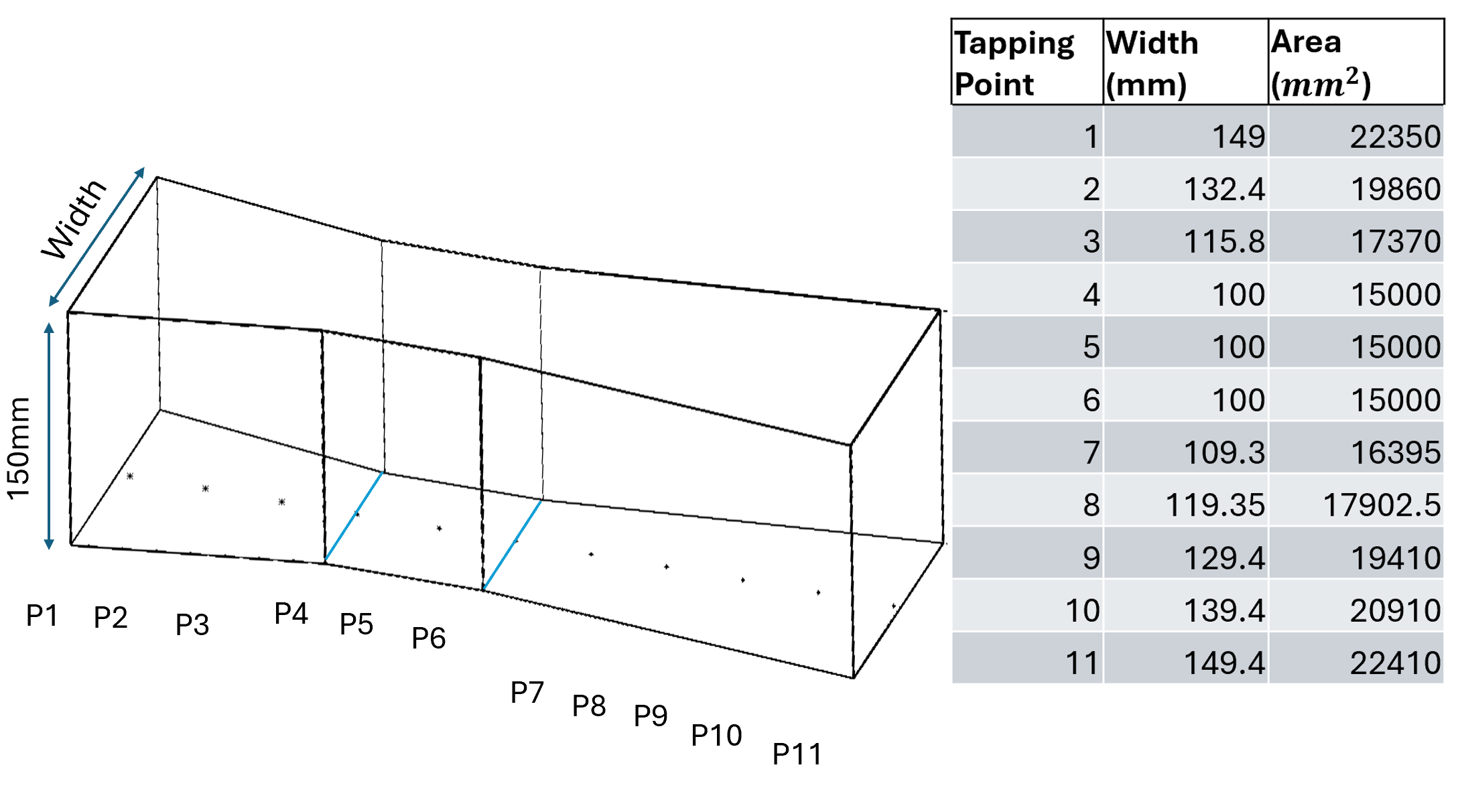
| Point | Zone | Dynamic pressure q (Pa) |
|---|
Pitot readings — inlet and diffuser
| Station | P₀ (Pa) | Ps (Pa) | ΔP (Pa) | V pitot (m/s) | V continuity (m/s) | Cp |
|---|
Static, dynamic and total pressure along the duct (Pa gauge)
In the throat (P4–P6) static pressure is at its lowest and dynamic pressure is at its highest. If you doubled the fan speed, how would the shape of the three curves change — and how would their magnitudes change?
